
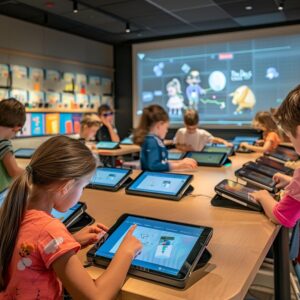
For Generation Alpha, technology isn’t just a tool, it’s part of how they experience and understand the world. As Augmented Reality (AR) and Virtual Reality (VR) become more accessible, these immersive technologies are transforming the way young people learn, communicate, and engage with their surroundings.
Imagine exploring the solar system without leaving the classroom, walking through ancient civilizations, or conducting science experiments in a safe virtual environment. AR and VR make learning more interactive, engaging, and memorable by turning abstract concepts into hands-on experiences. Instead of simply reading about a topic, Gen Alpha can experience it firsthand, helping improve understanding and long-term retention.
Communication is evolving too. Virtual spaces allow students to collaborate with classmates from different cities, or even different countries, in shared digital environments. These experiences encourage teamwork, creativity, and cross-cultural understanding while preparing young learners for a future where remote collaboration is increasingly common.
Immersive technology also supports different learning styles. Visual learners can explore detailed 3D models, while kinesthetic learners benefit from interactive activities that keep them actively involved. For students with certain disabilities, AR and VR can also create more inclusive learning experiences by providing customized environments and adaptive tools.
However, as exciting as these innovations are, balance remains essential. Technology should complement, not replace, real-world interactions, critical thinking, and meaningful human connections. Educators and parents play an important role in ensuring immersive technology is used responsibly, with appropriate screen-time limits and purposeful learning goals.
As AR and VR continue to evolve, they are shaping a generation that learns through exploration, collaboration, and experience. Organizations, educators, and leaders who embrace these tools thoughtfully will be better equipped to engage Gen Alpha in ways that inspire curiosity, build practical skills, and prepare them for an increasingly digital future.
How do you think AR and VR will shape the next generation of learners and communicators? Share your thoughts below.
Recent Comments