
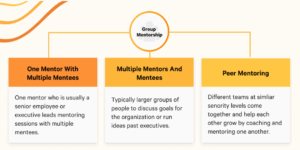
Here are some innovative ideas designed to enhance the effectiveness and engagement of group and cohort mentorship programs:
Core Program Design & Structure
- “Topic-Sprint” Cohorts:
- Description: Instead of long-term, open-ended mentorship, create short, intensive cohorts (e.g., 4-6 weeks) focused on a very specific skill or challenge (e.g., “Navigating Your First Management Role,” “Mastering Presentation Skills,” “Building Your Personal Brand”).
- Benefit: High engagement due to focused objectives, clear start/end dates, and immediate applicability of learned skills. Mentors can rotate based on expertise.
- Reverse Mentorship Pods:
- Description: Each cohort includes a mix of senior and junior professionals, but specific sessions or projects involve the junior members mentoring the senior members on topics like social media trends, emerging technologies, or Gen Z workplace dynamics.
- Benefit: Fosters mutual respect, breaks down hierarchical barriers, and ensures knowledge transfer in both directions.
- Peer-Led “Mastermind” Groups:
- Description: Within a larger cohort, establish smaller, self-directed “mastermind” groups (4-5 mentees) that meet independently between formal mentor sessions. These groups set their own agendas, share challenges, and hold each other accountable. Mentors can occasionally drop in.
- Benefit: Develops leadership skills within the mentee group, fosters strong peer bonds, and increases ownership of learning outcomes.
Engagement & Interaction Mechanisms
- “Challenge-Based” Mentorship:
- Description: Present the cohort with a real-world problem or case study relevant to their industry/goals. The mentor guides them through the problem-solving process, encouraging collaboration and critical thinking.
- Benefit: Applies theoretical knowledge to practical scenarios, promotes active learning, and simulates real work environments.
- “Skill-Share & Show-and-Tell” Sessions:
- Description: Dedicate specific cohort meetings for mentees (or even mentors) to present a skill they’ve recently learned, a project they’re working on, or a challenge they’ve overcome, followed by Q&A and feedback.
- Benefit: Encourages practical application, builds presentation skills, and allows for shared learning from diverse experiences.
- “Virtual Office Hours” & Asynchronous Q&A:
- Description: Beyond scheduled meetings, mentors host dedicated “virtual office hours” where mentees can drop in for quick questions. Complement this with an asynchronous platform (e.g., Slack channel, dedicated forum) for ongoing questions and discussions.
- Benefit: Provides flexible access to mentors, accommodates different time zones, and encourages continuous learning outside of formal sessions.
- “Speed Mentoring” Mixers:
- Description: Periodically, organize events where different cohorts or mentors can briefly connect with other mentors/mentees in short, focused bursts (e.g., 5-7 minutes per pairing) to exchange ideas or seek quick advice.
- Benefit: Expands networking opportunities beyond the immediate cohort, exposes mentees to diverse perspectives, and offers fresh insights.
Impact Measurement & Growth
- “Growth Metric” Tracking & Visualization:
- Description: Work with mentees at the beginning to define 1-3 personal growth metrics (e.g., public speaking confidence score, networking connections, project completion rate). Track progress visually throughout the cohort.
- Benefit: Provides tangible evidence of progress, motivates mentees, and helps mentors tailor guidance.
- “Alumni Network” Integration:
- Description: Create a formal or informal network for past cohort participants. Offer opportunities for alumni to return as guest speakers, peer mentors for new cohorts, or participate in advanced workshops.
- Benefit: Builds a sustainable community, provides ongoing support, and creates a pipeline for future mentors.
- “Mentor-Mentee Matching Algorithm” with Dynamic Adjustments:
- Description: Utilize a sophisticated algorithm that considers skills, goals, personality traits, and industry experience for initial matching. Allow for “re-matching” opportunities or “guest mentor” sessions if initial pairings aren’t optimal.
- Benefit: Increases the likelihood of successful mentor-mentee relationships and provides flexibility for evolving needs.
Unique Experiential Components
- “Shadow a Leader” Program:
- Description: As part of the cohort experience, arrange for mentees to spend a half-day or full-day observing a leader (not necessarily their direct mentor) in a different department or organization.
- Benefit: Provides invaluable real-world exposure, broadens understanding of different roles, and offers a unique perspective on leadership in action.
- “Community Impact Project” Cohorts:
- Description: The entire cohort collaborates on a pro-bono project for a non-profit or community organization, applying their developing skills under mentor guidance.
- Benefit: Develops teamwork, project management, and problem-solving skills in a practical setting while contributing positively to society.
- “Storytelling & Personal Narrative” Workshops:
- Description: Integrate sessions focused on helping mentees craft and articulate their professional story, elevator pitch, and career aspirations effectively. Mentors provide feedback.
- Benefit: Enhances communication skills, builds confidence, and helps mentees clearly define and convey their value.
- “Failure Forum” & Resilience Building:
- Description: Dedicate a session where mentors and mentees openly share past failures, lessons learned, and strategies for bouncing back. Emphasize that failure is a part of growth.
- Benefit: Normalizes setbacks, builds resilience, fosters a psychologically safe environment, and promotes a growth mindset.
- “Cross-Industry Exploration” Sessions:
- Description: Invite guest speakers from entirely different industries to share insights on transferable skills, emerging trends, and career paths that might not be immediately obvious to the cohort.
- Benefit: Broadens horizons, sparks innovative thinking, and helps mentees identify unexpected career opportunities or skill applications.














Recent Comments