Here are some creative and well-thought-out logical ideas for mentorship program design:
I. Innovative Matching & Structure
- “Skill Swap” Mentorship Circles:
- Concept: Instead of traditional one-way mentorship, create circles where each participant identifies a skill they want to learn and a skill they can teach. The circle then facilitates reciprocal learning, making everyone both a mentor and a mentee.
- Why it’s creative: Challenges the hierarchical norm, fosters mutual growth, and leverages diverse internal expertise.
- Logical application: Ideal for cross-functional skill development and fostering a collaborative learning culture.
- “Flash Mentoring Blitz” Events:
- Concept: Organize short, intensive virtual or in-person events where mentees rotate through multiple “flash mentors” for 15-20 minute sessions focused on specific, quick-hit challenges or questions.
- Why it’s creative: High-impact, low-commitment, and provides diverse perspectives quickly.
- Logical application: Great for addressing immediate needs, exposing mentees to many senior leaders, and breaking down perceived barriers to mentorship.
- “Project-Based Mentorship Pods”:
- Concept: Form small, cross-departmental pods (3-5 people) around a specific, short-term internal project or innovation challenge. A senior leader mentors the entire pod, guiding them through the project lifecycle while fostering collaboration and shared learning.
- Why it’s creative: Integrates mentorship directly into tangible work, provides real-world application, and builds team cohesion.
- Logical application: Excellent for leadership development, fostering innovation, and solving specific business problems.
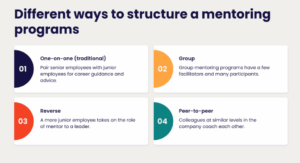
- “Reverse Shadowing” Program:
- Concept: Instead of the mentee shadowing the mentor, the mentor shadows the mentee for a set period (e.g., a day or half-day). The mentor observes the mentee’s daily work, challenges, and interactions, providing context-rich feedback afterward.
- Why it’s creative: Provides mentors with invaluable insight into current challenges faced by junior employees, bridging generational/experience gaps.
- Logical application: Promotes empathy, helps senior leaders understand evolving workplace dynamics, and can inform strategic decisions.
II. Engagement & Development Enhancements
- “Alumni Bridge” Mentorship:
- Concept: Connect current employees with company alumni who have moved on to diverse career paths or industries. This offers mentees broader career perspectives, external insights, and networking beyond the current organizational structure.
- Why it’s creative: Taps into an often-untapped resource, offers unique external viewpoints, and strengthens alumni relations.
- Logical application: Valuable for career exploration, understanding industry trends, and gaining diverse professional network connections.
- “Mentorship Storytelling Circles”:
- Concept: Beyond formal meetings, create informal “storytelling circles” where mentors and mentees share their personal career journeys, challenges, and breakthroughs. This builds deeper connections and offers relatable lessons.
- Why it’s creative: Fosters psychological safety, encourages vulnerability, and provides organic learning through shared experiences.
- Logical application: Strengthens trust, builds community, and provides a platform for informal knowledge transfer.
- “Challenge-Based Learning Paths”:
- Concept: Design mentorship paths around specific, predefined “challenges” (e.g., “Leading a Difficult Conversation,” “Navigating Cross-Functional Conflict,” “Developing a Strategic Plan”). Mentors guide mentees through resources and practical application related to that challenge.
- Why it’s creative: Provides a clear, actionable framework for development and makes the mentorship highly goal-oriented.
- Logical application: Ensures practical skill acquisition, makes progress measurable, and keeps sessions focused.
- “Mentorship Micro-Modules”:
- Concept: Provide mentors and mentees with short, curated “micro-modules” (e.g., 5-10 minute videos, short articles, quick exercises) on topics like active listening, giving feedback, goal setting, or confidentiality. These can be consumed before sessions.
- Why it’s creative: Elevates the quality of interactions by equipping both parties with foundational skills, without heavy training burdens.
- Logical application: Ensures consistent best practices, saves time on basic explanations during sessions, and provides ongoing support.
- “Gamified Mentorship Journey”:
- Concept: Introduce elements of gamification (points, badges, leaderboards for participation/completion of milestones, small rewards) to encourage consistent engagement and celebrate achievements within the program.
- Why it’s creative: Adds a fun, motivating layer to the program and can boost participation rates.
- Logical application: Drives engagement, encourages completion of program milestones, and creates a positive, competitive spirit.
III. Measurement & Sustainability
- “Public ‘Ask Me Anything’ (AMA) with Mentors”:
- Concept: Host regular, open Q&A sessions with a panel of mentors from various departments/levels. Employees can submit questions anonymously or live, providing broader access to mentorship insights.
- Why it’s creative: Democratizes access to senior wisdom, addresses common pain points, and showcases the value of the mentor pool.
- Logical application: Increases visibility of the program, provides quick answers to common questions, and encourages broader engagement.
- “Mentorship Impact Portfolio”:
- Concept: Encourage mentees to create a “portfolio” (digital or physical) documenting their learning journey, key takeaways from sessions, skills developed, and goals achieved. This can be shared with their manager (with permission) or used for self-reflection.
- Why it’s creative: Shifts focus from just attendance to tangible outcomes, provides a clear record of development, and empowers mentees.
- Logical application: Offers a concrete way to measure mentee growth, aids in performance reviews, and demonstrates ROI.
- “Pay-It-Forward Mentoring Chain”:
- Concept: Integrate a “pay-it-forward” principle where successful mentees are encouraged, after a certain period, to become mentors themselves, thus perpetuating the cycle.
- Why it’s creative: Creates a self-sustaining program, builds a pipeline of new mentors, and reinforces the value of giving back.
- Logical application: Ensures program longevity, reduces recruitment burden for new mentors, and strengthens organizational culture.
- “Data-Driven Relationship Health Checks”:
- Concept: Utilize anonymous, periodic pulse surveys (e.g., every 2-3 months) to gauge the health of mentor-mentee relationships (e.g., meeting frequency, perceived value, communication quality) without revealing specifics. Use aggregate data to identify common issues or successes.
- Why it’s creative: Provides real-time insights into program effectiveness and allows for proactive intervention or celebration.
- Logical application: Enables continuous improvement, identifies struggling pairs early, and validates successful strategies.
- “Cross-Organizational Mentorship Exchange”:
- Concept: Partner with a non-competing organization in a different industry or sector to facilitate a reciprocal mentorship exchange program. This offers truly external perspectives and broadens professional networks.
- Why it’s creative: Breaks organizational silos, provides fresh external insights, and fosters unique professional relationships.
- Logical application: Ideal for leadership development, fostering innovation through diverse thinking, and expanding talent networks.
- “Mentorship ‘Shark Tank’ for Internal Projects”:
- Concept: For high-potential employees or project teams, organize a “Shark Tank”-style event where they pitch an internal project idea to a panel of senior leaders (acting as mentors). The “mentors” provide critical feedback and guidance, potentially offering resources or sponsorship for promising ideas.
- Why it’s creative: Combines mentorship with practical application, leadership exposure, and potential for internal innovation.
- Logical application: Develops strategic thinking, presentation skills, and provides a platform for employees to contribute to organizational growth.














Recent Comments